
Lilac has retired to the Archive.
Its full monograph and preparation notes are now available in the Monograph Library.

SPOTLIGHT OF THE MONTH: BORAGE
Pollinators • Courage • Blue-Star Garden Medicine
This month, Borage steps forward for its role as:
• Pollinator Ally
• Garden Companion
• Cooling Tradition
• Courage Herb
• Safety Teacher
Borage is not subtle.
It arrives with bristled leaves, bright blue star-shaped flowers, and a way of pulling bees into the garden like it sent out invitations.
It is cheerful, a little unruly, and deeply useful to observe.
In old herbal traditions, Borage was associated with courage, gladness, and cooling support. In the garden, it is often grown for pollinators, edible flowers, and its generous self-seeding presence.
But Borage is also a plant that asks for responsibility.
This is not a “drink it every day because the internet said so” herb. Borage contains pyrrolizidine alkaloid safety concerns, especially around internal use, long-term use, pregnancy, breastfeeding, and poorly controlled preparations.
That makes it perfect for June.
Beautiful. Useful. Misunderstood.
Retiring to the Archive on July 1st.

WHY BORAGE FOR JUNE
A blue-star ally for garden abundance and responsible curiosity.
June is when the garden starts speaking louder.
Flowers open. Bees return with purpose. Heat builds. Everything feels a little more alive, a little less controlled.
Borage belongs to that moment.
It is generous without being polished. It sprawls, feeds pollinators, brightens the garden, and reminds us that usefulness does not always arrive neatly trimmed.
Seasonally, Borage has been associated with:
• bee gardens and pollinator support
• edible flower traditions
• cooling herbal preparations
• courage and gladness folklore
• summer abundance
• responsible plant safety education
Borage does not whisper from the edge of the garden.
It buzzes.

Here, in this temporary space before Borage joins the Archive formally, you’re invited to meet it through:
its physical character, bristled texture, and blue star-shaped flowers
its relationship with bees and summer garden ecology
its folklore around courage, gladness, and heartening the spirit
its traditional apothecary use with appropriate caution
a simple external-use craft suited to warm weather and botanical study
Borage is more than a pretty edible flower.
This month, Borage reminds us that beauty still requires discernment. A plant can be cheerful, useful, and worthy of caution at the same time.
Borage (Borago officinalis) carries the kind of garden presence people remember.
Its flowers are usually bright blue, star-shaped, and visually distinct. Its leaves are rough, bristled, and not especially delicate. It is often grown in herb gardens, vegetable gardens, and pollinator-friendly spaces.
Borage has been used historically as a culinary and traditional herb, but modern apothecary work needs to hold that history alongside safety concerns.
This is where the plant becomes more interesting.
Not less.
Borage (Borago officinalis)


Preparation & Best Practices
Borage is most commonly prepared using the aerial parts and flowers.
Common preparations include:
• Fresh flower preparations
Best practices include:
• Harvesting flowers shortly after opening
• Using fresh material whenever possible
• Drying gently to preserve color and quality
• Pairing with rose, lemon balm, or violet in floral blends
• Incorporating into seasonal and celebratory preparations
Borage is often most appreciated when used fresh, allowing its vitality and beauty to remain intact.
Best Extraction Practices
Borage extracts well in water, vinegar, and glycerin.
Fresh infusions capture its gentle floral qualities, while vinegar preparations preserve both minerals and color.
Because of its delicate nature, prolonged boiling is generally avoided.
Shelf Life in Storage
Borage should be stored in airtight containers away from heat, moisture, and direct sunlight.
Approximate shelf life:
• Dried aerial parts — 1 year
• Dried flowers — 6–12 months
• Vinegar extraction — 1–2 years
• Infusion — 24 hours refrigerated
Fresh material is preferred whenever available.
Safety Notes
Borage should be sourced carefully and used appropriately.
Traditionally, the flowers and aerial portions have been used in herbal preparations, while concentrated products and long-term use should be approached with awareness and proper research.
As with all herbs, preparation method and sourcing matter.
Energetic & Ritual Associations
Borage is considered cooling, moistening, and uplifting. It is often associated with courage, optimism, and emotional resilience, helping to restore brightness during periods of heaviness or discouragement.
Symbolically, borage represents:
Courage
Encouragement
Joy
Renewal
Open-heartedness
Its vivid blue flowers and abundant presence attract pollinators and attention alike, reflecting its long-standing reputation as a plant that invites both connection and vitality.
Borage carries the energy of hope made visible, reminding us that strength is not always forceful—sometimes it arrives as encouragement.
In the Archive With…
Often associated with herbs used for emotional support, seasonal nourishment, and floral preparations, including:
These plants frequently appear in formulations intended to support balance, encouragement, and gentle restoration, working together to create preparations that nourish both body and spirit.
Identity & Origin
Borage (Borago officinalis) is an annual flowering herb in the Boraginaceae family, native to the Mediterranean region and now cultivated and naturalized throughout much of Europe and North America.
Known for its vivid blue star-shaped flowers and softly bristled leaves, borage has been valued for centuries as both a medicinal and culinary plant. Traditionally, the leaves, flowers, and seeds have all been utilized, though the flowers and aerial portions are most commonly encountered in herbal preparations.
Borage has long held a reputation as a plant of courage, comfort, and upliftment, earning a place in both formal herbal traditions and folk practice.
Appearance & Character
Borage is a striking herb with fuzzy stems and leaves covered in fine white hairs. Its flowers emerge in clusters, hanging downward before opening into brilliant blue, star-shaped blossoms that attract bees and other pollinators in abundance.
The leaves are broad, textured, and cucumber-like in both scent and flavor. The flowers possess a subtle sweetness and delicate freshness.
Borage carries a cooling, moistening, and uplifting character. It softens heat and dryness while simultaneously bringing a sense of brightness and resilience.
Its nature is both nourishing and encouraging, offering support without heaviness.
Key Minerals & Constituents
Borage contains a variety of compounds that contribute to its traditional uses.
Key constituents include:
• Mucilage
• Flavonoids
• Minerals and trace nutrients
• Tannins
• Gamma-linolenic acid (primarily in the seed oil)
These contribute to its reputation as a soothing, restorative, and nourishing herb.
Historical & Cultural Context
Borage has a rich history stretching back to ancient Greece and Rome.
Traditionally, it was associated with:
• Courage and confidence
• Emotional fortitude
• Joy and upliftment
• Hospitality and celebration
Historical texts often referenced borage as a plant capable of "gladdening the heart," and it was frequently added to wines, cordials, and seasonal beverages.
In medieval Europe, borage flowers were sometimes floated in drinks during celebrations and festivals, symbolizing bravery and good cheer.
Its long-standing relationship with emotional support has made it one of the most beloved herbs in traditional folklore.
Uses in Apothecary Work
In herbal practice, borage is used to support:
• Cooling and moistening formulations
• Emotional and seasonal support blends
• Floral infusions
• Nutritive preparations
• Pollinator and garden medicine education
Borage is often incorporated into formulations where there is a desire for both nourishment and gentle upliftment.
Its flowers are particularly valued for adding beauty, symbolism, and seasonal character to herbal preparations.

Craft of the Month
Borage Flower Cooling Cloth
Warm-Weather Garden Cloth
External Use Only
A simple one-use preparation for summer botanical study, warm days, and garden-softened skin.
This is not medicine.
Not a treatment.
Not a stored skincare product.
It is a fresh, sensory plant craft for meeting Borage safely and briefly.
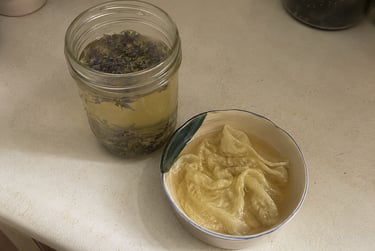
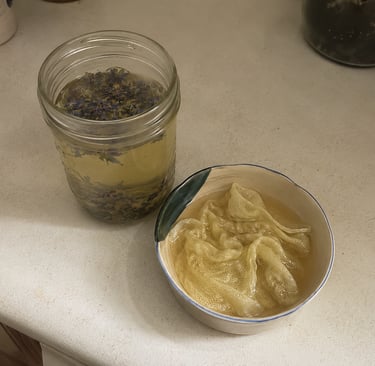
INGREDIENTS
Small Batch — 1 Use
• 1–2 tbsp fresh Borage flowers
• Optional: 1 tsp fresh chopped cucumber peel
• ½ cup cool water
• Clean cotton cloth
• Small bowl
Instructions
Prepare
Place fresh Borage flowers in a small clean bowl.
Add cucumber peel if using.
Infuse
Pour cool water over the plant material.
Let sit for 10–15 minutes.
Strain
Remove all plant material.
Do not leave flowers or leaves sitting in the water for storage.
Use
Dip a clean cotton cloth into the infused water.
Wring lightly.
Apply briefly to intact skin, such as the back of the neck, arms, or hands after garden work.
Discard
Discard remaining liquid immediately after use.
Do not bottle.
Do not store.
Do not reuse later.
WHY THIS CRAFT WORKS
(The Apothecary Breakdown)
Borage is being used here as a fresh, seasonal plant study - not as a treatment.
The cool water, fresh flowers, and cloth create a simple external ritual for warm weather without turning the plant into an overclaimed remedy.
Cucumber keeps the preparation light and sensory.
The short preparation time keeps it practical.
The discard-after-use instruction keeps it responsible.
This craft is about meeting the plant clearly:
blue flower
bee plant
summer presence
beautiful, useful, and not casual for internal use
Wild Medicine Apothecary
Contact
info@wildmedicineguide.com
+1-470-304-8111
© 2024. All rights reserved.
Kennesaw, GA
Wild Medicine Apothecary provides compliance education, documentation systems, and botanical reference materials for independent cosmetic brands.




Wild Medicine Guide provides educational resources and professional tools. It does not provide legal advice or regulatory certification.
Wild Medicine Guide is part of the educational work of Wild Medicine Apothecary.