
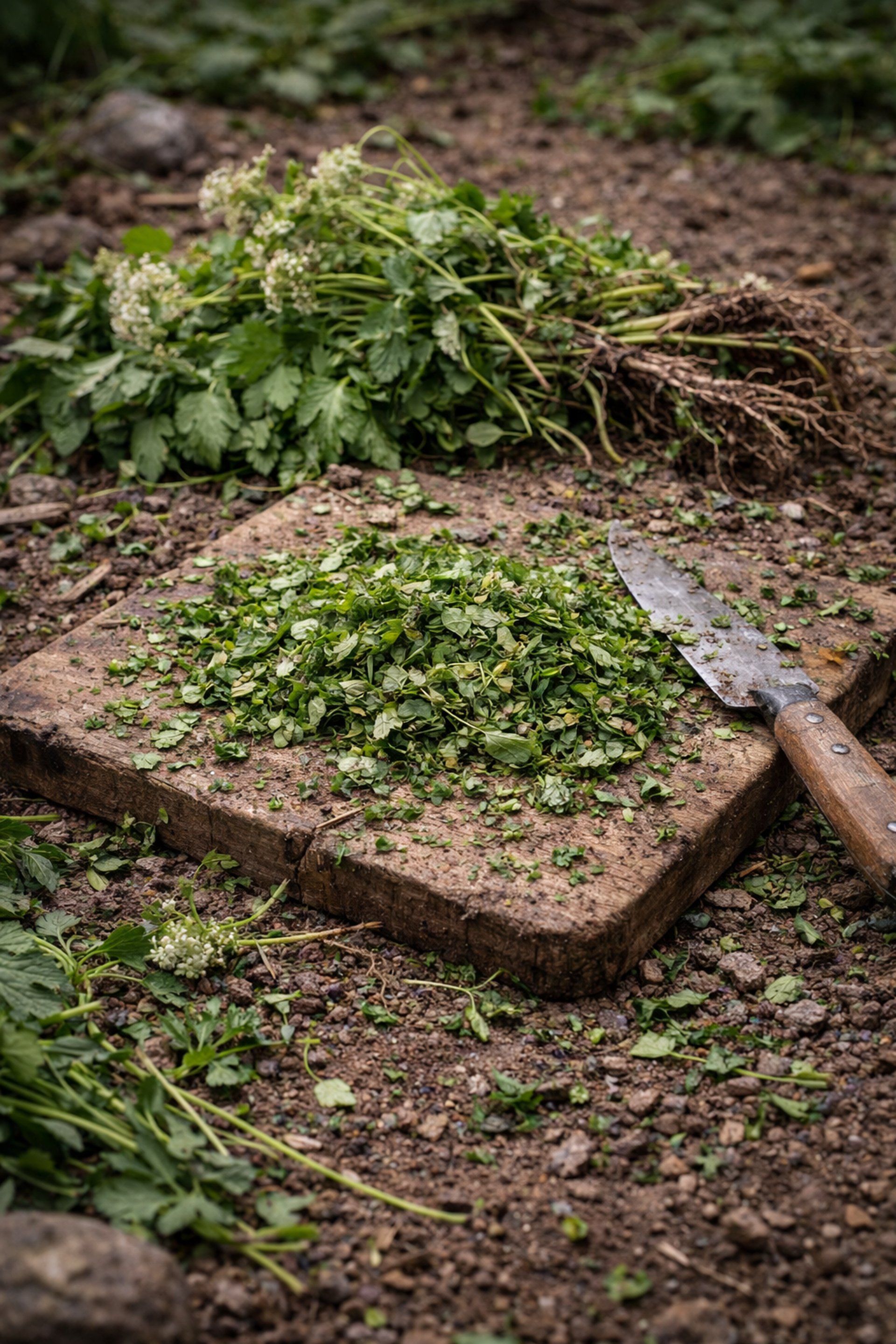
Ground Elder
Aegopodium podagraria
LEAVES & AERIAL HERBS
Ground Elder (Aegopodium podagraria)
Preparation & Best Practices
Ground elder is most commonly used fresh, where its qualities are most accessible.
Common preparations include:
• Fresh infusions
• Potherbs and culinary preparations
• Poultices
• Light tinctures
Best practices include:
• Harvesting young leaves for best flavor and texture
• Using fresh material whenever possible
• Combining with other green herbs such as nettle or chickweed
• Incorporating into seasonal or spring blends
• Avoiding older, tougher leaves for internal use
Ground elder works best when treated as a fresh, living plant, rather than a heavily processed material.
Best Extraction Practices
Ground elder is best used fresh or lightly processed.
Infusion works well for gentle extraction, while fresh use preserves its full character. It does not require prolonged or aggressive extraction methods.
Shelf Life in Storage
Ground elder is best used fresh.
Approximate shelf life:
• Fresh plant — use immediately or within a few days refrigerated
• Dried herb — up to 1 year (though less commonly used dried)
• Infusion — 24–48 hours refrigerated
Its quality diminishes significantly when dried compared to fresh use.
Safety Notes
Ground elder is generally considered safe when properly identified.
As a member of the Apiaceae family, care should be taken to ensure correct identification, as some plants in this family can be toxic. When properly sourced and identified, it has a long history of safe use.
Energetic & Ritual Associations
Ground elder is considered cooling, light, and gently clearing. It is often used when there is a need for freshness, renewal, and subtle movement, particularly in seasonal transitions.
Symbolically, it is associated with persistence, adaptability, and quiet resilience, reflecting its vigorous growth habit and ability to thrive in challenging conditions.
It carries a sense of gentle renewal, offering support that is light, accessible, and grounded in everyday use.
In the Archive With…
Often associated with fresh, green, and gently supportive herbs, including:
Chickweed
Nettle
Cleavers
Spring Infusions
These herbs frequently appear in formulations intended to support light cleansing, nourishment, and seasonal transition, working together to create preparations that are fresh, balanced, and easy to integrate into daily use.
Identity & Origin
Ground elder (Aegopodium podagraria), also known as goutweed, is a perennial herb in the Apiaceae (carrot) family, native to Europe and parts of Asia and now widely naturalized across North America.
It grows vigorously in shaded areas, woodland edges, and disturbed soils, often forming dense ground cover through spreading rhizomes. Because of this, it is sometimes considered invasive, though it has a long history of use as both a food and a medicinal plant.
The aerial parts—leaves and young shoots—are most commonly used in herbal practice, typically harvested in spring when the plant is tender and most palatable.
Appearance & Character
Ground elder has bright green, divided leaves with serrated edges, often appearing in clusters of three leaflets. It produces small white flowers in umbrella-like clusters, characteristic of the Apiaceae family.
When young, the leaves are soft and delicate, becoming tougher and more fibrous as the plant matures.
Its flavor is fresh, green, and slightly herbaceous, somewhat similar to parsley or celery, with a mild bitterness. The aroma is light and clean, without strong intensity.
Ground elder carries a cooling, light, and gently moving character. It feels refreshing and clearing without being harsh, offering a subtle but steady presence.
Key Minerals & Constituents
Ground elder contains a range of naturally occurring compounds that contribute to its traditional use.
Key constituents include:
• Flavonoids
• Vitamin C
• Minerals (in smaller amounts compared to deep nutritives like nettle)
• Mild bitter compounds
These contribute to its role as a lightly nutritive and gently supportive herb, often used in fresh preparations.
Historical & Cultural Context
Ground elder has a long history of use in European herbal traditions, where it was commonly cultivated in monastery gardens and used as both food and medicine.
It became particularly associated with traditional use for conditions involving the joints, which contributed to the name “goutweed.” It was often prepared as a potherb or simple infusion, reflecting its role as a functional food plant rather than a specialized remedy.
Over time, its vigorous growth habit led to it being viewed more as a garden weed, though its traditional uses remain relevant in herbal practice.
Uses in Apothecary Work
In herbal practice, ground elder is used to support:
• Light cleansing and refreshing formulations
• Fresh herbal preparations
• Gentle mineral and green herb blends
• Topical applications such as poultices
• Seasonal or spring formulations
Ground elder is best understood as a food-like herb, bridging nourishment and gentle herbal support.
It is often used when a lighter, fresher approach is desired, rather than deep or intense intervention.

Contact
info@wildmedicineguide.com
+1-470-304-8111
© 2026 Wild Medicine Apothecary LLC. All rights reserved.
Kennesaw, GA
Wild Medicine Apothecary LLC provides educational information and professional tools for general informational purposes. Content and resources do not constitute legal advice, medical advice, or regulatory certification.
Herbalism, formulation, folklore, research, and small-batch apothecary work under one roof.
From plant monographs and seasonal features to cosmetic formulation, maker education, and practical documentation systems.
Wild Medicine Apothecary


Check out my other rantings at Brainz Magazine
Root around on our socials here