
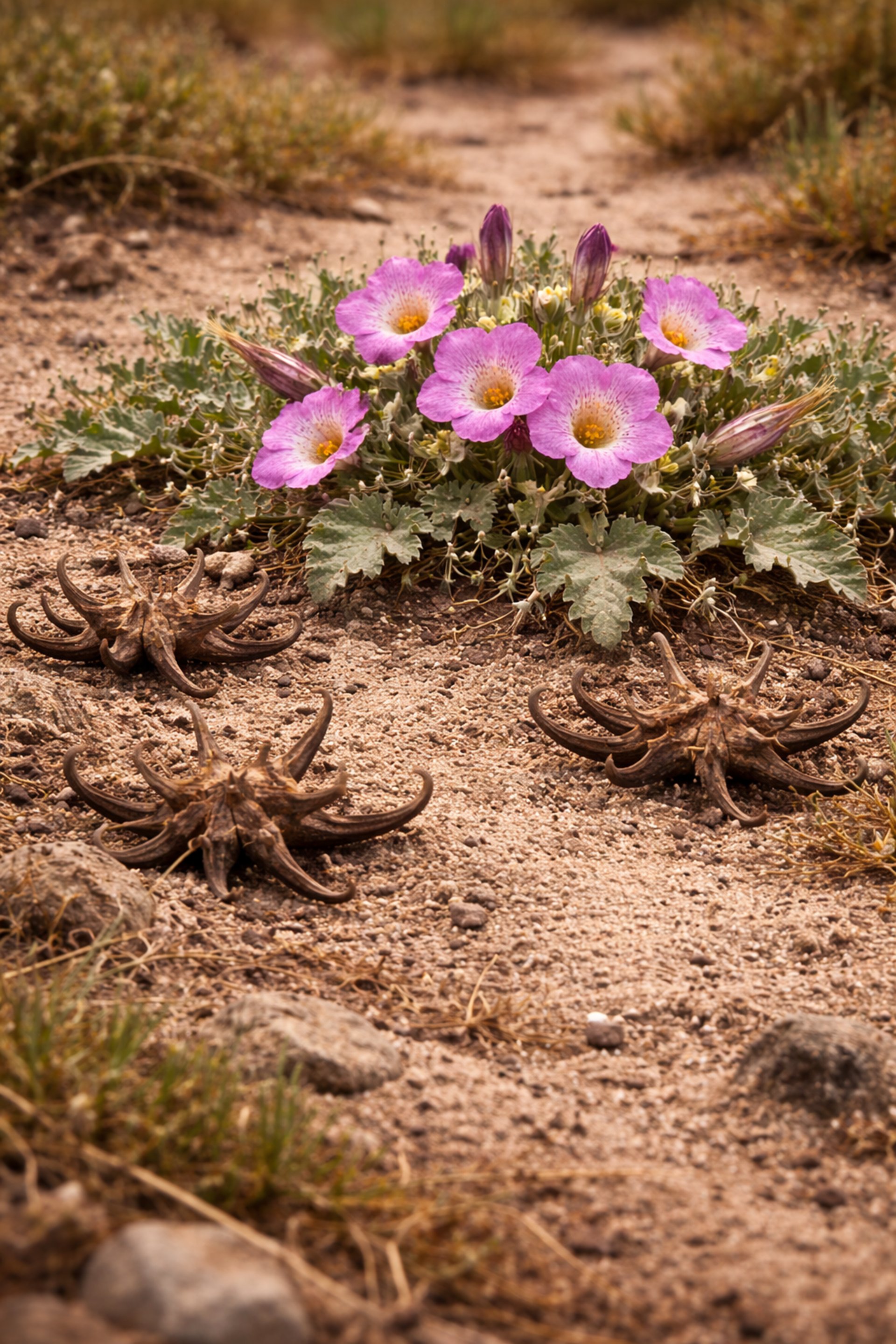
Devil's Claw
Harpagophytum procumbens
ROOTS AND BARK
Devil's Claw (Harpagophytum procumbens)
Preparation & Best Practices
Devil’s claw root is most commonly prepared as a decoction, allowing its dense structure to be fully extracted.
Common preparations include:
• Decoctions
• Tinctures
• Powdered forms
• Blended root formulas
Best practices include:
• Simmering for an extended period to fully extract its constituents
• Combining with other roots such as burdock, ginger, or turmeric for balance
• Using in moderate amounts due to its strong bitterness
• Incorporating into long-term formulations rather than short-term use
• Pairing with warming herbs to support overall balance
Devil’s claw is best approached as a deep, structural herb, used with intention rather than casually.
Best Extraction Practices
Devil’s claw root is best extracted through decoction or alcohol.
Decoction allows for full extraction of its dense root material, while tincture provides a concentrated and stable preparation. Because of its toughness, it benefits from prolonged extraction and proper preparation.
Shelf Life in Storage
Devil’s claw root should be stored in airtight containers in a cool, dry place away from direct light.
Approximate shelf life:
• Dried root — 2–3 years
• Tincture — 3–5+ years
• Decoction — 24–48 hours refrigerated
Its dense structure allows it to store well when properly dried.
Safety Notes
Devil’s claw should be used thoughtfully due to its potency.
Its strong bitterness may not be suitable for all individuals, and it is best used in appropriate formulations rather than in excess. As with all herbs, use should be guided by context and individual response.
Energetic & Ritual Associations
Devil’s claw is considered deeply grounding, drying, and strongly downward moving. It is often used when there is a need to bring attention back into the physical body or to address deeply rooted imbalance.
Symbolically, it is associated with endurance, resilience, and working through resistance, reflecting both its harsh growing environment and its firm nature.
It carries a sense of strength through challenge, offering support in situations that require persistence and structural integrity.
In the Archive With…
Often associated with roots used for deep, grounding, and structural formulations, including:
Burdock Root
Ginger
Turmeric
Ashwagandha
Decoction
These herbs frequently appear in formulations intended to support long-term balance and physical resilience, working together to create preparations that are strong, steady, and deeply rooted.
Identity & Origin
Devil’s Claw (Harpagophytum procumbens) is a low-growing, perennial plant native to the arid regions of southern Africa, particularly Namibia, Botswana, and South Africa. It belongs to the Pedaliaceae family and thrives in dry, sandy soils where few other plants can sustain themselves.
The plant produces sprawling stems and distinctive hooked fruits, which give rise to the name “devil’s claw.” Beneath the surface, it develops large, tuberous roots that are harvested and dried for use in herbal practice.
It is these secondary storage roots that are most commonly used, valued for their dense, concentrated nature and long-standing role in traditional systems.
Appearance & Character
Devil’s claw root appears as irregular, woody pieces with a rough exterior and a fibrous, dense interior. The color ranges from light brown to deep tan, with a dry, solid structure that reflects its desert origin.
Its taste is intensely bitter, one of the more pronounced bitter profiles among commonly used roots. There is very little sweetness or softness to it—its character is direct and unmistakable.
The aroma is subtle and earthy, without strong aromatic qualities.
Devil’s claw carries a deep, grounding, and strongly directive presence. It does not soften or gently guide like many herbs; instead, it works with a kind of firmness, often used where something more substantial is needed.
Key Minerals & Constituents
Devil’s claw root contains a range of compounds that contribute to its traditional use.
Key constituents include:
• Iridoid glycosides, particularly harpagoside
• Bitter compounds
• Phenolic compounds
• Flavonoids
These compounds contribute to its intensely bitter profile and its role as a structurally supportive root in herbal practice.
Historical & Cultural Context
Devil’s claw has a long history of use in traditional African herbal practices, where it has been valued for its role in supporting the body through physically demanding conditions.
It was traditionally prepared as a decoction or powder and used as part of daily or situational herbal care. Over time, it became more widely known beyond its native regions, entering Western herbal traditions as a notable bitter and structural root.
Its use reflects a tradition of working with plants that are strong, direct, and rooted in the physical body, often chosen for their depth rather than subtlety.
Uses in Apothecary Work
In herbal practice, devil’s claw root is used to support:
• Structural and physical comfort
• Bitter formulations
• Long-term supportive blends
• Root-based decoctions
• Grounding herbal formulas
It is especially valued in formulations that require a strong, anchoring presence, often used alongside other roots to build depth and effectiveness.
Because of its intensity, it is rarely used alone and is more commonly included as a key component within a broader formula.

Contact
info@wildmedicineguide.com
+1-470-304-8111
© 2026 Wild Medicine Apothecary LLC. All rights reserved.
Kennesaw, GA
Wild Medicine Apothecary LLC provides educational information and professional tools for general informational purposes. Content and resources do not constitute legal advice, medical advice, or regulatory certification.
Herbalism, formulation, folklore, research, and small-batch apothecary work under one roof.
From plant monographs and seasonal features to cosmetic formulation, maker education, and practical documentation systems.
Wild Medicine Apothecary


Check out my other rantings at Brainz Magazine
Root around on our socials here