
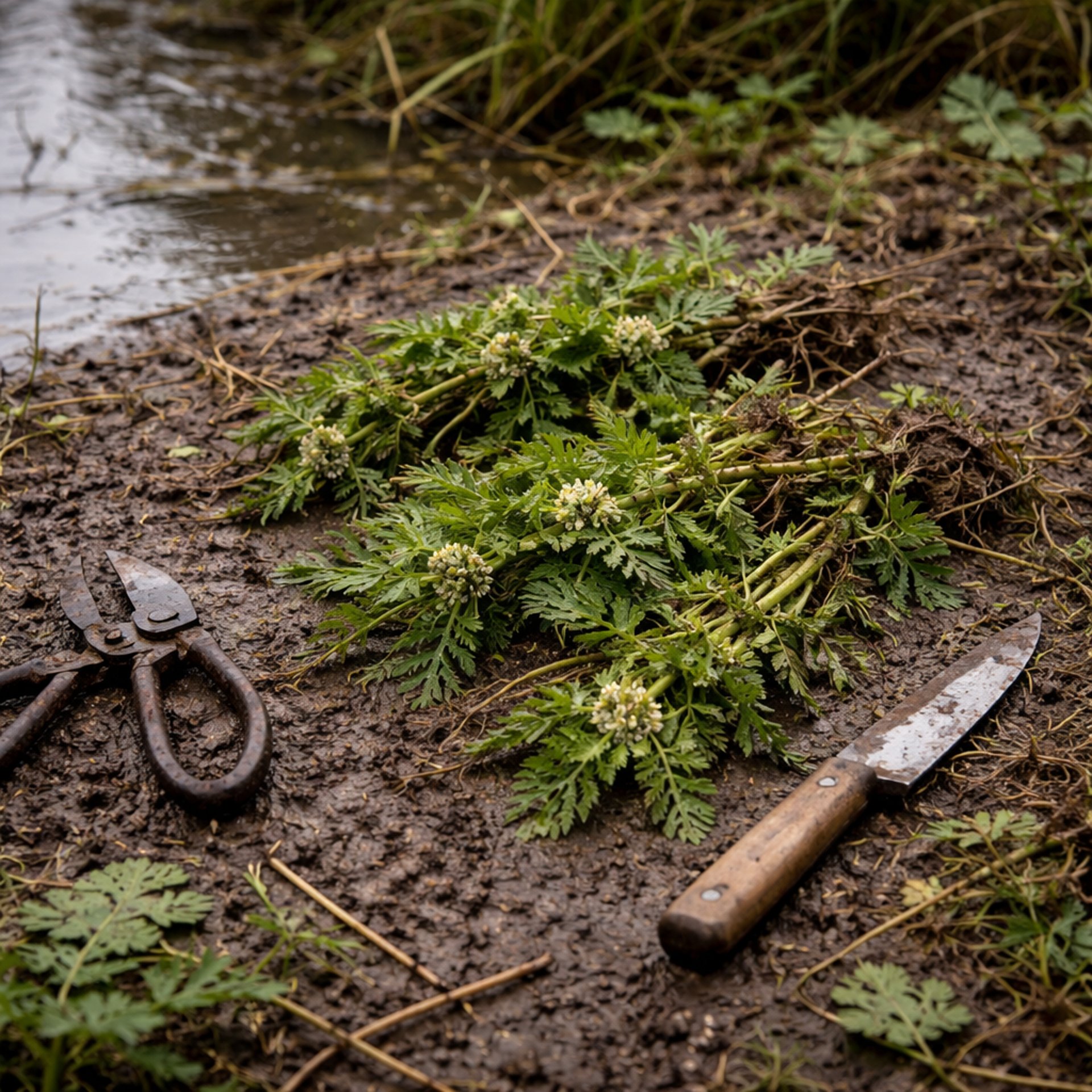
Gypsywort
(Lycopus europaeus in Europe and Lycopus americanus in North America)
LEAVES & AERIAL HERBS
Gypsywort (Lycopus europaeus in Europe & Lycopus americanus in North America)
Preparation & Best Practices
Gypsywort is most commonly prepared as an infusion or tincture.
Common preparations include:
• Infusions
• Tinctures
• Blended formulas
Best practices include:
• Using as part of a balanced formulation rather than alone
• Combining with lemon balm, skullcap, or motherwort for calming blends
• Using consistently over time for cumulative effect
• Avoiding overly strong combinations that override its subtle nature
Gypsywort works best as a supportive and harmonizing presence, rather than a dominant herb.
Best Extraction Practices
Gypsywort extracts well in both water and alcohol.
Infusion provides a gentle and accessible preparation, while tincture offers a more concentrated form. Its aerial nature makes it well suited to standard extraction methods without requiring prolonged processing.
Shelf Life in Storage
Gypsywort should be stored in airtight containers in a cool, dry place away from direct light.
Approximate shelf life:
• Dried herb — 1–2 years
• Tincture — 3–5+ years
• Infusion — 24–48 hours refrigerated
As with most aerial herbs, freshness contributes to overall quality.
Safety Notes
Gypsywort is generally considered safe when used appropriately.
Due to its moderating nature, it is best used with awareness of context and individual response. As with all herbs, proper identification and sourcing are important.
Energetic & Ritual Associations
Gypsywort is considered cooling, calming, and regulating. It is often used when there is excess, overstimulation, or imbalance, helping to bring the system back toward steadiness.
Symbolically, it is associated with balance, restraint, and quiet correction, reflecting its role as a plant that moderates rather than drives.
It carries a sense of subtle recalibration, offering support that is gentle, steady, and deeply regulating over time.
In the Archive With…
Often associated with herbs used for calming and regulating formulations, including:
Lemon Balm
Skullcap
Motherwort
Blue Vervain
Passionflower
These herbs frequently appear in formulations intended to support balance, calm, and nervous system regulation, working together to create blends that are steady, nuanced, and restorative.
Identity & Origin
Gypsywort (Lycopus europaeus in Europe and Lycopus americanus in North America) is a perennial herb in the Lamiaceae (mint) family. It grows in wet environments, commonly found along riverbanks, marshes, and damp meadows.
The plant thrives in consistently moist soil, often forming clusters in low-lying areas where water is present. The aerial parts—leaves and stems—are the portions most commonly used in herbal practice, typically harvested during the flowering stage.
Gypsywort has a long history of use in traditional European and North American herbalism, where it has been valued for its cooling, moderating, and regulating qualities.
Appearance & Character
Gypsywort is a modest, upright plant with square stems typical of the mint family. Its leaves are lance-shaped, serrated, and arranged oppositely along the stem, often with a slightly dark green tone.
It produces small, pale flowers that cluster around the leaf nodes rather than forming large, showy blooms.
When dried, the herb appears as a fine, leafy green material with a somewhat coarse texture.
Its taste is mildly bitter with a slightly astringent quality, and its aroma is subtle, with faint mint-like undertones.
Gypsywort carries a cooling, calming, and regulating character. It feels steady and moderating rather than stimulating or deeply nourishing, often working to bring systems back into a more balanced state.
Key Minerals & Constituents
Gypsywort contains a range of plant compounds that contribute to its traditional use.
Key constituents include:
• Phenolic compounds
• Flavonoids
• Tannins
• Lithospermic acid and related compounds
These contribute to its role as a regulating and moderating herb, particularly in formulations that aim to bring balance rather than force change.
Historical & Cultural Context
Gypsywort has been used in traditional European herbalism for centuries, often associated with calming and regulating the body during times of excess or imbalance.
It has historically been used in situations where cooling and moderation were needed, reflecting a broader herbal approach focused on restoring equilibrium rather than stimulating action.
The name “gypsywort” is thought to come from its historical use as a plant that could stain the skin, though its primary value has always been in its subtle but effective herbal applications.
Uses in Apothecary Work
In herbal practice, gypsywort is used to support:
• Regulation within the system
• Cooling and calming formulations
• Balancing blends
• Nervous system support
• Situations involving excess or overstimulation
Gypsywort is best understood as a modulating herb, helping to bring the system back toward balance without pushing strongly in one direction.
It is often used in formulations where softening, slowing, or regulating is needed.

Contact
info@wildmedicineguide.com
+1-470-304-8111
© 2026 Wild Medicine Apothecary LLC. All rights reserved.
Kennesaw, GA
Wild Medicine Apothecary LLC provides educational information and professional tools for general informational purposes. Content and resources do not constitute legal advice, medical advice, or regulatory certification.
Herbalism, formulation, folklore, research, and small-batch apothecary work under one roof.
From plant monographs and seasonal features to cosmetic formulation, maker education, and practical documentation systems.
Wild Medicine Apothecary


Check out my other rantings at Brainz Magazine
Root around on our socials here