
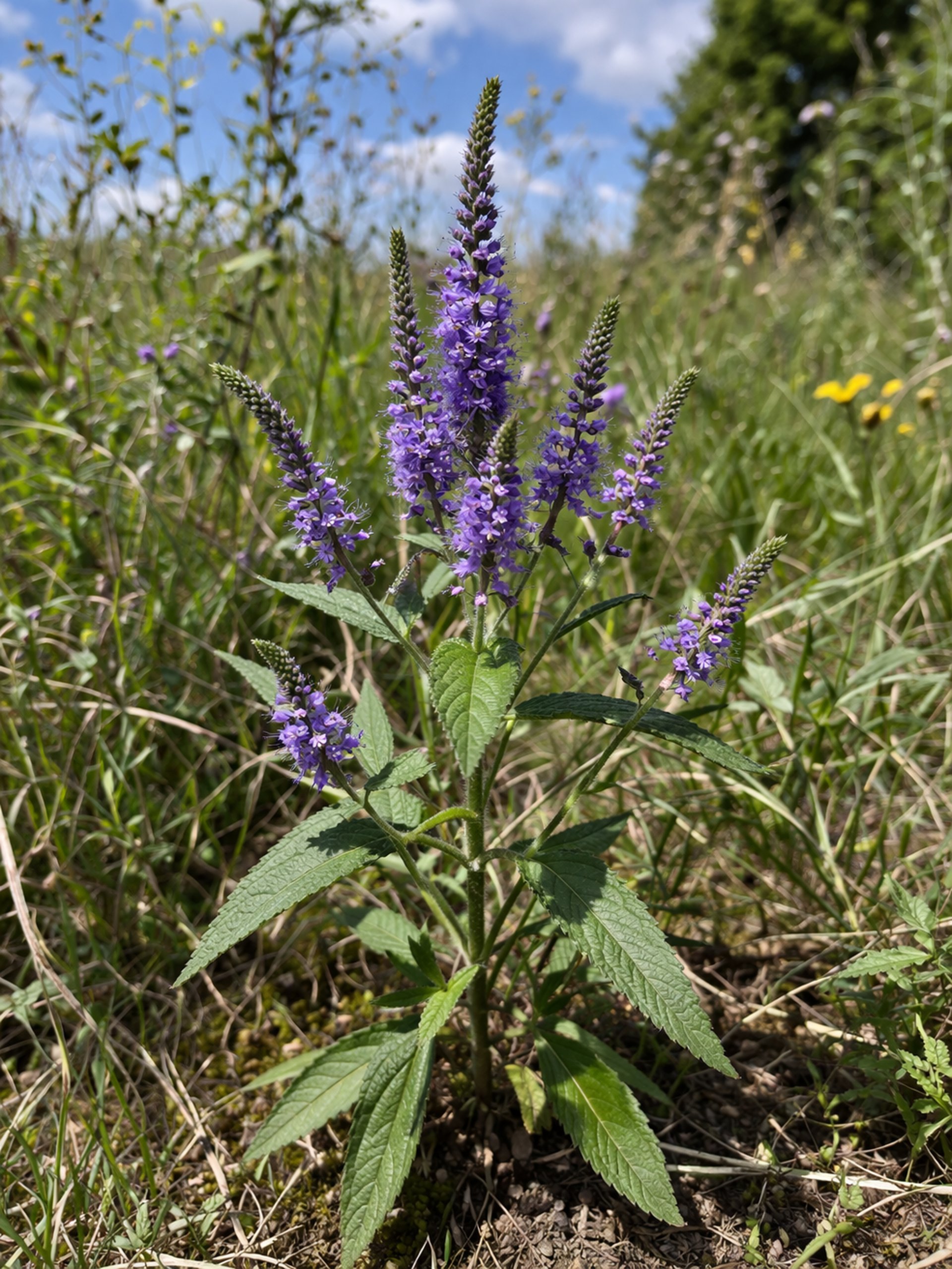
Blue Vervain
Verbena hastata
LEAVES & AERIAL HERBS
Blue Vervain (Verbena hastata)
Preparation & Best Practices
Blue vervain is commonly prepared in several traditional ways.
Common preparations include:
• Infusions
• Tinctures
• Compound nervine formulas
Best practices include:
• Use tincture for full-spectrum extraction and a more concentrated preparation
• Prepare as an infusion when using in blends, especially with gentler herbs
• Combine with skullcap, lemon balm, or passionflower in nervine formulas
• Pair with chamomile or lavender to soften bitterness and broaden the formula
• Use in moderate proportions, as its bitterness and directing quality can be strong
• Include it when a formula needs structure, tension-release, or downward movement
Blue vervain is often most effective not as a casual tea herb, but as a purposeful formula herb. It tends to shine when used intentionally in blends rather than as a large, pleasant standalone infusion.
Best Extraction Practices
Blue vervain is best extracted through:
• Alcohol (tincture)
• Infusion
Tincture is often preferred because it captures its bitter and active nervine qualities more fully and offers a more concentrated form.
Infusion is still useful, especially in blended formulas, though its strong bitterness often makes it less appealing as a simple tea on its own.
Because of its nature as a bitter, regulating aerial herb, blue vervain works especially well in preparations that preserve both its directing quality and its nervine depth.
Shelf Life in Storage
Blue vervain should be stored in:
• Airtight containers
• Cool, dry conditions
• Away from direct light
Approximate shelf life:
• Dried herb — 1–2 years
• Tincture — 3–5 years
• Infusion — 24–48 hours refrigerated
As with many aerial herbs, freshness, aroma, and color help indicate quality over time.
Safety Notes
Blue vervain is generally considered a safe herb when used appropriately.
Important considerations include:
• Its bitterness may not be suitable for everyone
• It is best used thoughtfully and in moderate amounts
• Individual response may vary, especially in more concentrated preparations
Because it has a strong personality in formulas, it is often best approached with intention rather than used casually or excessively.
Energetic & Ritual Associations
In traditional herbal energetics, blue vervain is often considered cooling, bitter, and downward-moving, with a strong affinity for releasing tension held in both the body and mind.
It is frequently used when there is rigidity, overexertion, internal pressure, or an inability to soften, especially in those who hold themselves tightly through responsibility, control, or relentless effort.
Symbolically, blue vervain is associated with release, surrender, recalibration, and sacred unwinding, reflecting its long-standing role as a plant that helps ease the grip of intensity.
It has often been regarded as a herb for those who push beyond their limits, offering support in returning to steadiness, humility, and natural rhythm rather than force.
In the Archive With…
Often associated with nervine and balancing formulations, including:
Skullcap
Lemon Balm
Chamomile
Passionflower
Tincture
These herbs and methods frequently appear in preparations intended to support nervous system balance, relaxation, and tension release.
Identity & Origin
Blue vervain (Verbena hastata) belongs to the Verbenaceae family.
It is native to North America, where it commonly grows in moist meadows, along streambanks, ditches, wet fields, and other lowland areas. It is a plant of open, often transitional places, thriving where water and movement are present.
Key identifying features include:
• Tall, upright stems that may reach several feet in height
• Slender, branching spikes of small blue to violet flowers
• Opposite, lance-shaped leaves with toothed edges
• A preference for damp soils and sunny to partly sunny locations
Parts traditionally used:
• Aerial parts — leaves and flowering tops
Blue vervain is most often harvested while in flower, when the plant is at its most expressive and traditionally preferred for medicine making.
Appearance & Character
Blue vervain is a tall, elegant, somewhat wiry plant with slender flowering spikes and narrow, serrated leaves.
Its flowers appear as many tiny blue to violet blossoms arranged on thin, upright spikes, often branching in a candelabra-like form near the top of the plant. The leaves are dark green, elongated, and opposite along the stem, giving the plant a structured, vertical character.
When dried, blue vervain appears as:
• Green to brown aerial plant material
• Thin stems with narrow leaves
• Delicate, elongated flower spikes
Its taste is distinctly:
• Bitter
• Slightly drying
• Mildly earthy
Its aroma is subtle and herbaceous rather than strongly fragrant.
Blue vervain has a firm, clarifying, and somewhat austere character, especially when compared with softer, sweeter nervines. It does not feel lush or indulgent; it feels precise, cooling, and directive.
Key Minerals & Constituents
Blue vervain contains a range of active compounds that contribute to its traditional use.
Key constituents include:
• Iridoid glycosides, including verbenalin
• Bitter compounds
• Flavonoids
• Tannins
These contribute to its role as a bitter nervine herb with a distinctive affinity for tension, overexertion, and regulation.
While it is not usually thought of as a nutritive mineral herb in the same way as nettle or oatstraw, its medicinal value lies in its bitterness, nervine action, and shaping influence within formulas.
Historical & Cultural Context
Blue vervain has a long history in North American and European herbal traditions, where it has been valued as both a medicinal and symbolic plant.
It has traditionally been associated with:
• Nervous system regulation
• Emotional release
• Ritual and ceremonial use
• States of intensity, burden, and internal strain
Historically, vervain species were often regarded as plants of protection, purification, and sacred intention, appearing in ritual contexts as well as practical herbal use.
In North American herbal practice, blue vervain became especially known as an herb for those who are driven, tense, mentally overextended, or unable to relax their internal grip. Its long-standing reputation reflects a plant that supports not only the body, but also patterns of holding, striving, and excess effort.
Uses in Apothecary Work
In herbal practice, blue vervain is commonly used to support:
• Nervous system tension and strain
• Mental overexertion
• Emotional rigidity or internal pressure
• Physical holding patterns related to stress
• Bitter-tonic and nervine formulas
Commonly used parts
• Aerial parts — tinctures, infusions, blended formulas
Blue vervain is especially well known as a directive nervine, often appearing in formulas intended to support people who are tense, driven, perfectionistic, or carrying too much pressure mentally and physically.
Rather than simply sedating, it is traditionally used to help unwind, soften, and recalibrate patterns of over-control and chronic effort.

Contact
info@wildmedicineguide.com
+1-470-304-8111
© 2026 Wild Medicine Apothecary LLC. All rights reserved.
Kennesaw, GA
Wild Medicine Apothecary LLC provides educational information and professional tools for general informational purposes. Content and resources do not constitute legal advice, medical advice, or regulatory certification.
Herbalism, formulation, folklore, research, and small-batch apothecary work under one roof.
From plant monographs and seasonal features to cosmetic formulation, maker education, and practical documentation systems.
Wild Medicine Apothecary


Check out my other rantings at Brainz Magazine
Root around on our socials here